Traffic Light Workshop
Putting the Traffic Light Framework into Practice
Workshop facilitated by Michael Cheng, PhD, PEng; Brian Moher, Hons. BA, LL.B.; and Tidimogo Gaamangwe, PhD, PEng
8 December 2026 | 1:30–2:30 pm | Stream D, Montreal 3
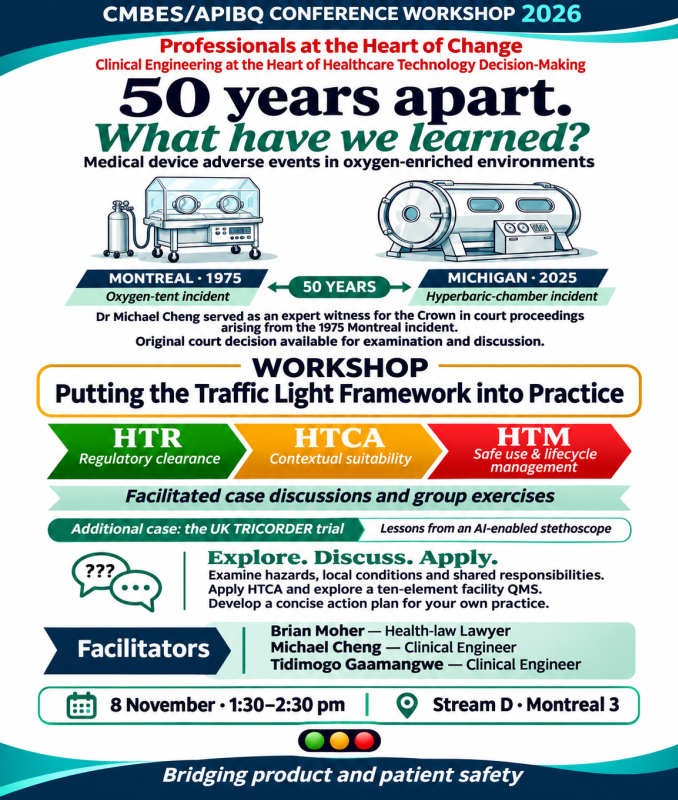
What can two medical device incidents involving oxygen-enriched environments, separated by 50 years, teach us about medical device safety? And why might an AI-enabled stethoscope show promising detection performance without producing significant improvements in diagnosis when introduced into routine clinical practice?
This workshop examines the oxygen-tent incident in Montreal on 21 August 1975 and the 2025 Michigan hyperbaric-chamber incident. Facilitator Michael Cheng (PhD, PEng) served as an expert witness for the Crown in the Montreal proceedings in 1977. He will share his firsthand insights into the device’s design and the regulatory arrangements of the 1970s. Health-law lawyer Brian Moher (Hons. BA, LL.B.) will guide participants through the Montreal oxygen-tent court decision and the allegations and issues surrounding the Michigan hyperbaric chamber incident. These materials provide a basis for examining how medical device regulation has evolved, how responsibilities are assigned, and what structured safeguards healthcare facilities need to protect patients during clinical use.
An additional case, the UK TRICORDER trial of an AI-enabled stethoscope, will prompt discussion of the conditions needed to translate technical capability into clinical benefit. Participants will explore how the Traffic Light Framework could help identify deployment requirements, anticipate implementation barriers and plan the introduction of sophisticated digital technologies.
The framework connects three complementary stages: regulatory clearance through health technology regulation (HTR); local suitability through health technology contextual assessment (HTCA); and safe use and lifespan management through health technology management (HTM), supported by a facility quality management system (QMS).
The central takeaway is that HTCA provides a bridge between product and patient safety, positioning clinical engineering at the heart of healthcare technology decision-making within healthcare facilities. Facilitator Tidi Gaamangwe (PhD, PEng) will demonstrate the practical significance of the proposed ten-element QMS: an auditable structure that facilities can adapt to their circumstances.
Through facilitated case discussions and group exercises, participants will examine intended use, environmental hazards, staff competence, operating procedures, maintenance and organizational oversight. What should be assessed before introducing a technology? What must be controlled throughout its use? How should manufacturers, healthcare facilities, clinical teams and clinical engineers share responsibility? Which lessons remain relevant across different technologies and periods?
Interested participants will also be invited to contribute to a brainstorming session, “Putting Clinical Engineering at the Heart of Healthcare Technology Decision-Making: What Will It Take?” This session will provide an opportunity to share experiences, identify priorities and propose practical next steps.
About the Facilitators
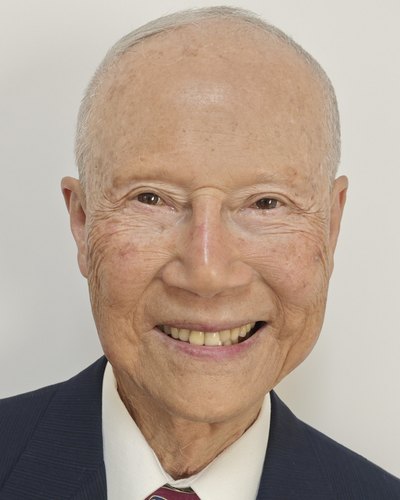
Michael Cheng
PhD, PEng
Michael Cheng has worked in medical device safety, clinical engineering and international advisory work for more than five decades. He investigated adverse events at Health Canada’s Bureau of Medical Devices and, in 1977, served as an expert witness for the Crown in the prosecution arising from the 1975 Montreal oxygen-tent incident.
He has since advised WHO, the World Bank and other agencies in nearly 30 countries and developed WHO’s 2003 “Green Book” on medical device regulation. His work on a three-stage approach to device safety, now the Traffic Light Framework, appears in the Clinical Engineering Handbook (2nd ed., 2020).
Brian Moher
Hons. BA, LL.B.
Brian Moher is a lawyer whose practice has focused almost exclusively on health law, with a particular interest in medical devices and their regulation. He has extensive experience in medical device class actions and cross-border litigation.
He is also a researcher, writer and speaker in clinical engineering, psychology, and public health law and policy.
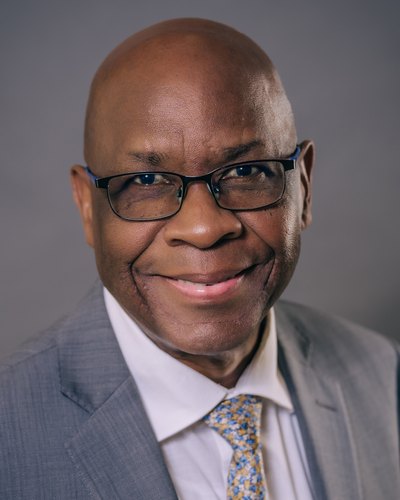
Tidimogo Gaamangwe
PhD, PEng
Tidimogo (Tidi) Gaamangwe is a senior advisor and founder of Pula Consulting LLC, with more than 25 years of operational leadership in healthcare technology management. He works with health system leaders on medical technology life-cycle, data quality and audit-ready regulatory compliance.
He previously served as Senior Executive Director and Chief Clinical and Diagnostic Technology Officer in Winnipeg, and led the national healthcare technology management division of Botswana’s Ministry of Health. He holds a PhD in Systems Design Engineering (Biomed) from the University of Waterloo.